
AI Isn’t the Problem. Chaos Is.
There is a lot of talk about AI right now.
For some, the conversation is exciting—full of promises of a frictionless future. For others, it is overwhelming, often framed around a central, looming fear: Will AI take my job? Will it replace the people who make this company what it is?
From our experience at GoWest.ai, that framing misses the point entirely.
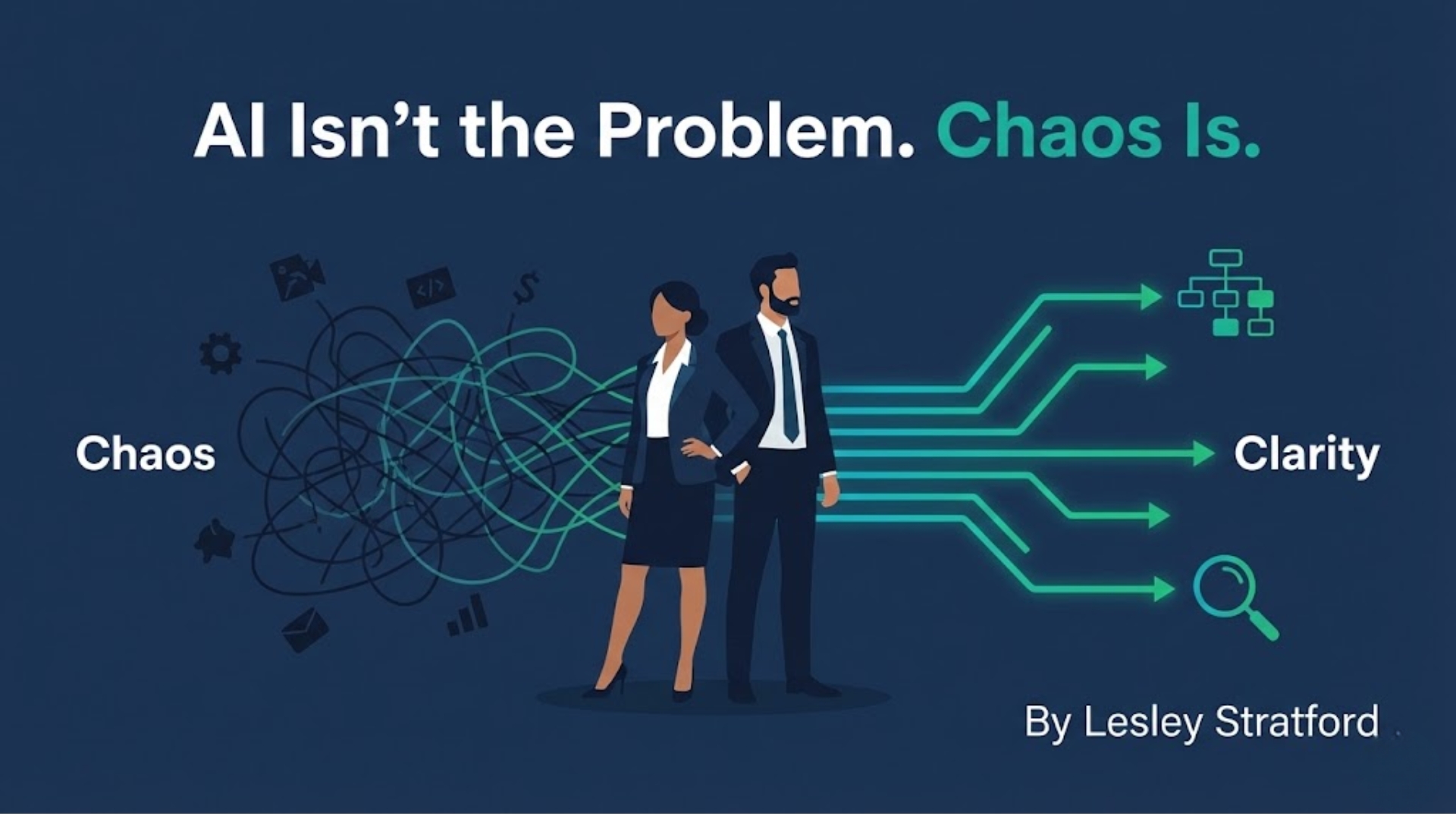
The real enemy isn't a sophisticated algorithm; it’s the quiet, compounding chaos that defines the modern workday. Operational AI is not about replacing people. It is about reducing the chaos that prevents those people from doing their best work.
The Hidden Weight of Operational Chaos
In most small and growing businesses, chaos—not a lack of talent—is the real problem.
Teams are rarely struggling because they have too many people or because those people aren't working hard enough. They struggle because the people they do have are carrying too much "administrative debt." When we look at organizations through our diagnostic lens, we see the same patterns:
Emails pile up like an unscalable wall.
Tasks live in too many places (Slack, Trello, sticky notes, and "mental tabs").
Processes exist only in someone’s head, making every departure a minor catastrophe.
Follow-ups slip through the cracks and critical context gets lost in the shuffle.
Everyone is busy—exhausted, even—but they aren't always moving the right things forward. This is the definition of operational chaos. It’s a state where energy is spent managing the work rather than doing the work.
We saw this vividly with a client in the healthcare space. Their team was highly skilled, yet they were drowning in a sea of submission letters and a constant barrage of insurance denials. The culprit wasn’t a lack of medical expertise; it was the impenetrable chaos of Medicare and Medicaid regulations. With an ever-changing landscape of rules, exclusions, and configuration requirements, ensuring that a medical solution would actually be covered became a nearly impossible task for human memory alone. The breaking point came when they realized that even their best people couldn't keep up with the "bureaucratic noise." They didn't need more staff to write more letters; they needed a system that could parse the rules and flag exclusions before the letters were ever sent. It was a classic chaos problem masquerading as a staffing shortage.
AI as a Friction-Reducer, Not a Decision-Maker
This is where operational AI actually helps.
Its most powerful role isn't as a primary decision-maker or a replacement for human judgment. Instead, its value lies in its ability to act as a friction-reducer. When AI is applied operationally, it takes on the repetitive, low-value work that currently drains your team’s cognitive energy.
Think about the "robotic" tasks that fill your day. AI can summarize a 60-minute meeting into three actionable bullet points. It can surface the right document at the exact moment it's needed. It can route customer requests to the right department automatically or highlight a project bottleneck before it turns into a fire.
By bringing structure to processes that were previously informal or undocumented, AI creates a consistent visibility across teams. None of this removes the need for people; what it removes is the constant drain of work that does not require human insight.
The Bottleneck of Clarity
In operations, bottlenecks rarely come from a lack of effort. They come from a lack of clarity.
Teams lose an incredible amount of time and energy asking the same questions over and over: Who owns this? What is the next step? Has this already been done? Where does the latest version of this information live? This is where the GoWest.ai philosophy comes in. For the last two years, we’ve focused on the "Human Side" of this equation. We know that you can't fix a lack of clarity with a tool alone; you have to fix the process first.
That’s why we created BizVantage.ai. We realized that finding the source of the chaos is the hardest part for most leaders. BizVantage.ai acts as an automated "readiness tool" that helps companies become expert interviewers. It identifies where the context is being lost and where the handoffs are failing. By using AI to diagnose the chaos, we free up time to build the clarity that humans need to thrive.
When work is tracked consistently and AI handles the "visible flow," handoffs are reduced and everyone shares the same context. Your team spends less time chasing answers and more time moving work forward.
We recently worked with a client who faced a recurring monthly nightmare: manufacturer claims and refunds. The data they needed lived inside their ERP, but getting it out required hundreds of manual mouse clicks and navigating through dozens of fragmented screens. Once they finally extracted the data, they had to export it to Excel, spend hours manipulating the information, and then manually submit it. It was a process that swallowed entire days of their team’s month. By implementing an AI-driven automation layer, we transformed those "hundreds of clicks" into a streamlined, visible flow. The team stopped being data entry clerks and started being analysts. The stress of "claim week" simply evaporated because the chaos of the retrieval process was replaced by the clarity of automated accuracy.
The Quiet Return: Clarity as a Growth Strategy
AI value is often discussed in terms of raw speed or immediate cost savings. Those outcomes certainly matter, and they are often the easiest to put on a spreadsheet. But they are not the full story.
The quieter, more sustainable return on operational AI is clarity.
Clear processes mean that onboarding is seamless and "tribal knowledge" becomes "organizational intelligence."
Clear ownership means that individuals know exactly what they are responsible for, reducing the anxiety of the unknown.
Clear priorities ensure that the team is rowing in the same direction.
Clear signals allow you to see when something starts to drift off course long before it crashes.
Clarity lowers stress. It leads to better, faster decisions. Most importantly, it allows businesses to grow without burning people out. When the "chaos tax" is removed, the business becomes scalable.
Beyond the Flash: Sustainable Growth
It isn’t flashy. A perfectly routed support ticket or an automatically updated project status doesn't make for a "viral" tech demo. But for the person who no longer has to spend two hours a day on manual data entry, it changes everything.
Clarity is not a luxury for high-performing teams; it is an essential requirement for sustainable growth. When operations are designed to reduce chaos instead of adding to it, teams can finally do the work they were hired to do—the work that requires empathy, creativity, and human strategy.
Most operational problems don't begin as major failures. They begin as small, chaotic issues that no one had the time or space to notice early. AI gives you that space back.
At GoWest.ai, we don’t start with the platform; we start with the people. If you are ready to move from the exhaustion of chaos to the power of clarity, we would be glad to help you find the way.
Last updated: January 25, 2026